





Change Nation: Ron Dembo (4/22/08)
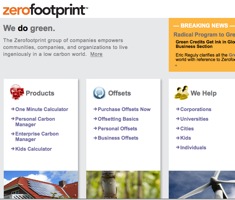
Mathematician Ron Dembo is applying his knowledge of science and engineering to one of the greatest missions of our time—creating a greener world. He is the founder and CEO of Zerofootprint.net, a not-for-profit organization that helps people measure their environmental impact in order to guide them in reducing their overall footprint. Dembo has taught at Yale University in the department of computer science and the school of management and is the co-author of three books, including Everything You Wanted to Know About Offsetting But Were Afraid to Ask, with Clive Davidson. In this special Earth Day episode of Change Nation, Dembo explains why Sweden is an ideal green country, debunks the myths that keep us from making radical change and encourages you to take small but significant steps to go green.
What is the good news about the environment?
I think the best news is that the level of awareness of environmental issues has really changed dramatically over the last year or so and people are actually doing things that are both profitable and have a big impact. So a lot has started. You know, you can actually see how people will mobilize. That’s what so exciting.
Are you seeing [change] more at a grass roots level or are you seeing it in businesses?
It’s happening almost in three layers. Certain governments are really getting it and doing stuff that’s quite amazing. The business community has taken this on in an extensive way and there is a lot of grass root [action]. When I say certain governments, I wouldn’t include our government [Canada], for example, and perhaps the U.S. as well. Grass roots [movements] are taking off mainly because of the lack of government action in our country.
What governments do you think do merit some credit and acknowledgement?
I think the UK and a lot of Europe—Spain, Germany, Norway and Sweden. I’d say the one of most interest is Sweden because they’ve been at this for a long time and they’ve created quite a culture of green. To give you a pretty quick summary, an average Swede has one-third the footprint of an average American and yet they live as well or better. They’ve really managed to cut their carbon dramatically.
Why is it that so many of us are not taking this more seriously at a consumer level?
You know there is a real disconnect. I’m sitting in a wonderful room now, the lights work, perfectly heated, my computer is working, the electricity is constant and you are trying to tell me that the world is going under. It’s really very hard to connect what you are experiencing now with what’s actually happening. You can’t connect the fact that this little action that you are going to take when you change your light bulb or switch off your screen saver is really going to make a difference—it doesn’t seem to make a difference, yet it does.
What do you think is the most important myth that we’re still buying into?
There is a myth that there is a silver bullet. That, you know, we are going to discover hydrogen [is the answer] and we will suddenly be able to drive Hummers based on hydrogen and life will be just as good as it was and we won’t have to do anything. The reality is we are going to have to change the way we do things.
Explain in really easy terms what a carbon footprint is and why it is so important.
When you perform any service or build any product or live in a heated or a cooled building, you are using energy. Typically that energy comes from burning fossil fuels. Whenever you burn fossil fuels you are taking carbon that has been stored for centuries deep down in the ground and you’re releasing that in the form of carbon dioxide into the atmosphere. That gas actually stays in the atmosphere for a long time and forms a layer around the earth. As that layer increases in density you capture more and more of the heat of the earth. So in some sense what you are doing is you are taking the earth out of balance.
What are some very practical things [to do] that you might be able to inspire us to actually execute this time?
The first thing to note is that more than 40% of all the energy in North America is used to operate buildings like your home and office. To put that into perspective, if you took every SUV out of North America, that would be 3% of the energy. So if you were to improve the efficiency of how you operate your home or your office by 10%, you would do more [for the environment] than taking all SUVs off the road. [You can do this] just by wearing a sweater [when you’re cold] or wearing lighter clothes in summer or using natural ventilation.
What are the most important things an individual can do as they start on the first 30 days of being green?
I think the very first thing to do is to look at the way that you heat and cool your house and see what you can do to reduce that by any amount. Start by measuring [your energy use] and pick the areas where you have the biggest impact. [Usually] the biggest impact would be flying, [energy use in] your home and [consumption]. There is a very simple way to reduce your footprint and that is to consume less.
SIGNATURE QUESTIONS
What is the belief that you personally go to in times of change?
I’d say it’s the connections to other humans.
The best thing about change is…
…that it forces us out of our box.
What is the best change you have ever made?
The best change I’ve ever made is going into completely new fields where I can apply the stuff I’ve learned. In the case of [environmentalism] it’s applying financial engineering and good software to the world of green and if you look around there is not a lot of that.
For more information on Ron Dembo, visit Zerofootprint.net.
About Ron Dembo
Mathematician Ron Dembo is applying his knowledge of science and engineering to one of the greatest missions of our time—creating a greener world. He is the founder and CEO of Zerofootprint.net, a not-for-profit organization that helps people measure their environmental impact in order to guide them in reducing their overall footprint. Dembo has taught at Yale University in the department of computer science and the school of management and is the co-author of three books, including Everything You Wanted to Know About Offsetting But Were Afraid to Ask, with Clive Davidson.



| "Ariane is a new voice who can inspire and inform all of us going through change, whether it be big or small, professional or personal. The First 30 Days will encourage people going through change to go from being fearful and alone to feeling optimistic and transformed."— David Bach, New York Times best-seller | "Since change is the only constant in life, it helps to have an expert navigate through the ups and downs of life. The First 30 Days is an excellent guide."— Deepak Chopra, New York Times best-seller | "Essential reading for anyone going through a change. I loved it!"— Wayne Dyer, New York Times best-seller |

Family Being Pregnant Being a New Dad Grieving Stepparenting
Home Selling a Home Buying a Home Surviving a Natural Disaster Creating a Green Home Your Empty Nest Remodeling Your Kitchen Buying a New Car
Relationships Improving Your Sex Life Getting Divorced Breaking Up Finding Romance Improving Relationships Dating Online
New Directions Pursuing Your Dreams Being Happier Changing Your Look Getting Organized Making Change Easier Moving to a New City Living More Spiritually Meditating Going Green
Health Dealing With Depression Quitting Smoking Managing Breast Cancer


Save Your Marriage OR Get Your Ex lover Back!Powerful Love Spells That Work Fast contact dr.unity at: Unityspelltemple@gmail.com OR Whats-app him: +2348055361568.
Hi, I’m Natasha. I’m a wife, mom to 3 kids and After 14years of marriage, me and my husband has been into one quarrel or the other until he finally left me and moved to California to be with another woman. I felt my life was over and my kids thought they would never see their father again. i tried to be strong just for the kids but i could not control the pains that torments my heart, my heart was filled with sorrows and pains because i was really in love with my husband. Every day and night i think of him and always wish he could come back to me, I was really worried and i needed help, so i searched for help online and I came across a website that suggested that Dr Unity can help get ex back fast. So, I felt I should give him a try. I contacted him and he told me what to do and i did it then he did a Love spell for me. 11hours later, my husband really called me and told me that he miss me and the kids so much, So Amazing!! So that was how he came back that same day,with lots of love and joy,and he apologized for his mistake,and for the pain he caused me and the kids. Then from that day,our Marriage was now stronger than how it were before, Thank you dr.unity for bringing back my husband and i recommend dr.unity for anyone who is having troubles in their marriage/relationship.Here’s his contact Call/Whats-app: +2348055361568 ,or Email him at: Unityspelltemple@gmail.com ,website:https://drunity.simplesite.com
My love life has changed for better since the interference of the most powerful spell caster on earth called Dr.Atase in my relationship, My testimony today is in regard of the help that Dr.Atase render me when my lover departed from me. My name is Anabel from USA and it gives me joy today in writing this testimony as a way of showing my appreciation to Dr.Atase and at the same time i am using this opportunity to advise those that are finding stress and pains in their relationship or marriages to contact Dr.Atase who is the best spell caster in the world through these contact details via email: indiaspelltemple@yahoo.com or his number +2348112796070.Because Dr.Atase is the only one that can restore your marriage or relationship with love. He can also help to win lottery spell,contract,sickness and more.
Hello dear friend,
To love someone is nothing, to be loved by someone is something, to love
someone who loves you is everything. Looking here for everything of my
life, I write some words. I am single and not engaged. I am in search of
true happiness and am hoping the future brings it. I am almost too honest
for my own good - and hate game playing.
nI am trying to handle some pretty encompassing issues in my life... but am
waiting to remain open-minded where the idea of romance exists. I am
looking for Honest, caring, patient, funny and loyal person. A man that
can be himself in the beginning and remain that same person all the way
through to the end of time !
nIf you are willing to love and be loved with your whole heart & willing to
make the people in your life a "solid' part of your soul... then maybe you
and I will connect. We might just have a lot to talk about through my
private e-mailbox(maryluveu@hotmailcom)
my contact info is.
Take care,
Ms mary maryluveu[at]ho/t/m/a/i/l/com
I agree. I've been making an effort not to waste water when I brush my teeth, wash the dishes, etc. and doing lots of other little things, like declining bags when I really don't need one, using my tote when I'm shopping, walking more/driving less, washing clothes in cold water. I've changed my lightbulbs.
Every little bit helps. No one will do this for us, so we have to each take responsibility.
I truly believe that if we all do one thing to conserve energy we can save our planet. The simplest thing to do would be to switch to energy saving bulbs for all your lights. The initial expense may be more than regular ones but what you save in energy and money will help all of us.