

|


Fawn Fitter on Dealing with Depression
After a major bout of depression left Fawn Fitter unable to work for several months, she discovered that there were many people struggling with similar concerns about how to integrate the illness into their working lives. Fitter co-authored, with Beth Gulas, Working in the Dark: Keeping Your Job While Dealing with Depression. In this interview, Fitter explains how those dealing with depression can cope while succeeding at their jobs.
Should people tell their boss and/or co-workers that they’re suffering from depression?
It depends on their boss and their workplace. People should ask themselves what they want to accomplish by telling their boss and whether it’s a safe environment where they feel comfortable confiding this to their boss. Although depression has become much more accepted, there are still a lot of harsh stereotypes about the condition. If you’re seeking time off from your job, it might be easier to say, “I’m not feeling well. Is it OK if I take a couple days off and make up the time later?”
How can people get through the workday while striving to overcome depression?
Take a walk during your lunch hour or break at work. Talk to someone, either an employee assistance counselor or a confidant at work (be sure you can trust this person to keep your confidence). Come up with a plan and talk to your boss about strategies that may help make you feel better—telecommuting, shifting responsibilities, etc.
What should people do if their daily coping techniques at work aren’t helping?
People may decide to use sick time or take a brief leave of absence rather than try to work through the worst of the crisis. Since depression is undoubtedly cutting into their concentration and productivity, they may be so incapacitated that they can’t function. More importantly, most people probably don’t have the luxury of unlimited time off. Try to plan ways to cope—to set your depression aside for a few hours a day—until treatment takes effect and your mood starts to lift.
What if people suspect their jobs are contributing to their depression?
They need to ask themselves questions such as, “Am I working in a stressful and unhealthy workplace?” “Do I have a problem with the boss?” “Am I doing work I enjoy?” “Am I physically and emotionally comfortable in the workplace?” “Am I being asked to do too much with too few resources?” Being in the throes of depression isn’t the best time to make a life decision such as leaving your job, but sometimes it’s necessary. We interviewed one woman for our book whose boss had a violent temper and once threw a bookcase at several employees. If you work in an atmosphere that’s toxic, you need to leave.
What can people do to make things easier at work when they’re depressed?
They need to take care of themselves so that they’ll have the strength to cope. Treat yourself with generosity and patience. Avoid major changes in your daily routine and cut back on your responsibilities whenever possible. Make a point of putting in “face time” even though isolation can be tremendously tempting. Make time for yourself in your schedule and ask for changes in your work situation as needed. For example, you might consider asking to telecommute or for part-time hours if this will help you get through the first 30 days and make you more productive.
What are some of the things people can do to stay happy at work?
They can take advantage of employee assistance programs that are completely confidential and can help them through this difficult time. Sometimes it helps to talk to your boss about the performance expectations he or she has for you. If you’re depressed about the job you’re in, maybe there’s an opportunity to transfer within the company or to pursue a job that offers an opportunity to develop your skills.
Can work ever help a person’s depression?
Yes. Since one of the typical symptoms of depression is choosing to be alone, a job can provide a comfortable routine and force you to get out and be around others. If you stay at home, your depression will often be exacerbated.
SIGNATURE QUESTIONS
What is the belief you personally go to during times of change?
This, too, shall pass.
“The best thing about change is...”
...it’s an opportunity that takes you out of your routine.
What’s the best change you have ever made?
I was successfully treated for depression through a combination of medications and therapy and I’m a stronger person because of the experience.
For more information on Fawn Fitter, visit www.workinginthedark.com.
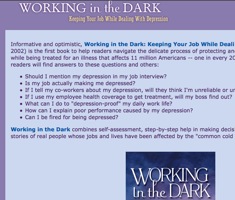
Working in the Dark: Keeping Your Job While Dealing With Depression


Each year, an estimated 11 million Americans experience a major depressive episode. Keeping a job while struggling to regain one's health is one of the most difficult and delicate aspects of recovery from depression....



| "Ariane is a new voice who can inspire and inform all of us going through change, whether it be big or small, professional or personal. The First 30 Days will encourage people going through change to go from being fearful and alone to feeling optimistic and transformed."— David Bach, New York Times best-seller | "Since change is the only constant in life, it helps to have an expert navigate through the ups and downs of life. The First 30 Days is an excellent guide."— Deepak Chopra, New York Times best-seller | "Essential reading for anyone going through a change. I loved it!"— Wayne Dyer, New York Times best-seller |

Family Being Pregnant Being a New Dad Grieving Stepparenting
Home Selling a Home Buying a Home Surviving a Natural Disaster Creating a Green Home Your Empty Nest Remodeling Your Kitchen Buying a New Car
Relationships Improving Your Sex Life Getting Divorced Breaking Up Finding Romance Improving Relationships Dating Online
New Directions Pursuing Your Dreams Being Happier Changing Your Look Getting Organized Making Change Easier Moving to a New City Living More Spiritually Meditating Going Green
Health Dealing With Depression Quitting Smoking Managing Breast Cancer


AM A LIVING WITNESS AND A BENEFICIARY OF DR OGUDU LOVE SPELL, PREGNANCY SPELL AND MARRIAGE REUNITING, CONTACT HIM NOW FOR YOUR MARRIAGE AND RELATIONSHIP PROBLEMS SOLUTION WITHIN 48 HOURS OF CONTACTING HIM
My name is CINDY SCOTT am from BELARUS, am a woman who loves and cherish my husband more than any other thing you can imagine on earth surface. My husband was so lovely and caring after 9 years of marriage he was seriously ill and the doctor confirm and said he has a kidney infection that he needed a kidney donor, that was how I started searching for a good Samaritan who can help,doctor has given me a periodic hour that he will live just 2 days left, that was how I ask the doctor if I can be of help to my husband that was how he carried out the test,the confirming was successful, I was now having this taught that since 9 years now we got married I have not be able to get pregnant can I be able to get pregnant again after thr surgery? That was the question I ask the doctor, he never answer his response was do you want to lost your husband? I immediately reply no I can't afford to loose him. After the operation i and my husband came back home and live happily as husband and wife should. After 7 months my husband came home with another lady telling me, that is our new wife that will give us kids and take care of us, that was how I was confused and started crying all day, That was not enough soonest my husband ran away with the new find love and never keep in contact with me. Since then I was confuse don't no what to do that was how I went back to the doctor and tell him everything, he told me that, this is not just an ordinary thing that he have heard of us situation so many times but he knows a man who is a voodoo spell caster who can help me out of my present situation that he has directed more 6 woman to him and they all came back with positive testimonials about him that I should tell him all my problem that he can help me out that was how i contacted him and i did as instructed. After 3 days and I have done what he ask me to do, my husband started searching for me that was how we settle he also told me not to worry that I will get pregnant, this month making it the fifth Month I contacted him am now 3 months pregnant. These great spell cater is a great man, if you are in any kind of problem you can contact him here on his email OGUDUSPELLTEMPLE@YAHOO.COM...WHATSAPP NUMBER +2348106058254...WEBSITE...Link
My love life has changed for better since the interference of the most powerful spell caster on earth called Dr.Atase in my relationship, My testimony today is in regard of the help that Dr.Atase render me when my lover departed from me. My name is Anabel from USA and it gives me joy today in writing this testimony as a way of showing my appreciation to Dr.Atase and at the same time i am using this opportunity to advise those that are finding stress and pains in their relationship or marriages to contact Dr.Atase who is the best spell caster in the world through these contact details via email: indiaspelltemple@yahoo.com or his number +2348112796070.Because Dr.Atase is the only one that can restore your marriage or relationship with love. He can also help to win lottery spell,contract,sickness and more.
What if you were so out of it, consumed with despair, you couldn't get out of bed. Anyway you end up losing your job. What do you do then? You have no job and you are more depressed than ever?! Wendy