

|


Dr. Tal Ben-Shahar on Being Happier
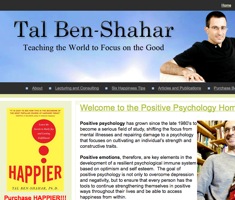
Everyone dreams of being happier, and Tal Ben-Shahar, Ph.D., understands this yearning. He’s a lecturer at Harvard University, where his “Positive Psychology” class boasts the university’s largest attendance. In addition to consulting and lecturing about happier living around the world, he recently published Happier: Learn the Secrets to Daily Joy and Lasting Fulfillment. Here, he shares his insights on being happier.
Do people have control over their happiness or is their degree of happiness dictated by genetics?
While there’s some genetic component to our happiness—some people are born with a happy disposition while others are not—our genes define a range, not a set point. Grumpy may not be able to cultivate the same view of life that Happy enjoys, and a natural-born whiner may not be able to transform himself into a Pollyanna. But we all can become significantly happier. Most people fall far short of their happiness potential.
Is there a limit to how happy a person can be?
We can always be happier; no person experiences perfect bliss at all times and has nothing more to which he can aspire. Therefore, rather than asking myself whether I’m happy or not, a more helpful question is, “How can I become happier?” This question acknowledges the fact that the pursuit of happiness is an ongoing process that’s best represented by an infinite continuum, not by a finite point. Rather than feeling despondent because we have not yet reached the elusive point of perfect happiness or squandering our energies trying to gauge how happy we are, we recognize that there are unlimited resources of happiness, and then focus on ways in which we can attain more of it.
In your book, you refer to happiness as the ultimate currency. How can this concept be helpful in the first 30 days of being happier?
A human being, like a business, makes profits and suffers losses. For a human being, however, the ultimate currency is not money, nor is it any external measure, such as fame, fortune or power. The ultimate currency for a human being is happiness.
Money and fame are subordinate to happiness and have no intrinsic value. The only reason money and fame may be desirable is that having them, or the thought of having them, could lead to positive emotions or meaning. In themselves, wealth and fame are worthless: There would be no reason to seek fame and fortune if they did not contribute, in some way, toward happiness.
How can a person reinforce their happiness through rituals in the first 30 days?
Ask yourself: “What rituals would make you happier? What would you like to introduce to your life?” It could be working out three times a week or meditating for fifteen minutes every morning or going on a date with your spouse on Tuesdays. Introduce no more than one or two rituals at a time and make sure they become a habit before you introduce new ones. According to research, it takes about 30 days to form a new ritual. Once a practice becomes a ritual, you can move on to the next one.
How can people enjoy the first 30 days of being happier?
Life is mostly about the journey, and yet most people live under the illusion that once they reach a certain destination—regardless of the journey—they’ll be happy. The reason why we see so many rat racers around is that our culture reinforces this delusional state. If we get an “A” at the end of the semester, we get a gift from our parents; if we meet certain quotas on the job, we get a bonus at the end of the year. We learn to focus on the next goal, rather than on our present experience, and chase the ever-elusive destination our entire lives.
Attaining lasting happiness requires us to enjoy the journey on our way toward a destination we deem valuable. Happiness is not about making it to the peak of the mountain, nor is it about climbing aimlessly around the mountain; happiness is the experience of climbing toward the peak.
How can being happier lead to success in everyday life?
Research illustrates that the relationship between happiness and success is reciprocal: Not only can success—be it at work or in love—contribute to happiness, but happiness also leads to more success.
Other factors being equal, happy people have better relationships, are more likely to thrive at work and live better and longer. Happiness is a worthwhile pursuit, whether as an end in itself or as a means toward other ends.
What types of goals should people set during the first 30 days of being happier?
The goals we should set are ones that will yield the most in the ultimate currency. It’s more important to have goals rather than to achieve them because the attainment of goals leads to a temporary high only. The proper role of long-term goals is to liberate us, so that we can enjoy the here and now. If we set off on a road trip without any identified destination, the trip itself will not be much fun. If we have a destination in mind, we are free to focus our full attention on making the most of where we are.
How can helping others lead to being happier?
We get so much benefit from helping others that I sometimes believe that there’s no more selfish act than a benevolent act. The philosopher Ralph Waldo Emerson wrote, “It is one of the most beautiful compensations of life that no man can sincerely try to help another without helping himself.” Helping oneself and helping others are inextricably intertwined: The more we help others, the happier we become, and the happier we become, the more inclined we are to help others.
In your book you speak about “happiness boosters.” What are they and how can people use them beyond the first 30 days?
One or two happy experiences during an otherwise uninspiring period can transform our general state. I call these brief, but transforming experiences “happiness boosters”—activities lasting anywhere between a few minutes to a few hours that provide us both meaning and pleasure, both future and present benefit.
Happiness boosters can also help in the difficult process of change; habits often persist even if we do recognize the need for a new or altered course of action. Introducing relatively brief experiences of meaning and pleasure is less threatening than overhauling an entire life and will, therefore, meet with less resistance—subconsciously from the person trying to change, as well as from the person’s social environment. Happiness boosters represent a more moderate, less risky approach toward bringing about change.
SIGNATURE QUESTIONS
What is the belief you personally go to during times of change?
While change is hard, the consequences of no change are much harder.
“The best thing about change is...”
That it’s possible.
What’s the best change you have ever made?
My commitment to my personal happiness, which came after my understanding that happiness is the ultimate currency.
For more information about Dr. Tal Ben-Shahar, visit www.talbenshahar.com.
Happier: Learn the Secrets to Daily Joy and Lasting Fulfillment


Grounded in the revolutionary "positive psychology' movement, Ben-Shahar combines scientific studies, scholarly research, self-help advice, and spiritual enlightenment. ...



| "Ariane is a new voice who can inspire and inform all of us going through change, whether it be big or small, professional or personal. The First 30 Days will encourage people going through change to go from being fearful and alone to feeling optimistic and transformed."— David Bach, New York Times best-seller | "Since change is the only constant in life, it helps to have an expert navigate through the ups and downs of life. The First 30 Days is an excellent guide."— Deepak Chopra, New York Times best-seller | "Essential reading for anyone going through a change. I loved it!"— Wayne Dyer, New York Times best-seller |

Family Being Pregnant Being a New Dad Grieving Stepparenting
Home Selling a Home Buying a Home Surviving a Natural Disaster Creating a Green Home Your Empty Nest Remodeling Your Kitchen Buying a New Car
Relationships Improving Your Sex Life Getting Divorced Breaking Up Finding Romance Improving Relationships Dating Online
New Directions Pursuing Your Dreams Being Happier Changing Your Look Getting Organized Making Change Easier Moving to a New City Living More Spiritually Meditating Going Green
Health Dealing With Depression Quitting Smoking Managing Breast Cancer


How I Got My Ex Husband Back...........
I am Shannon by name. Greetings to every one that is reading this testimony. I have been rejected by my husband after three(3) years of marriage just because another woman had a spell on him and he left me and the kid to suffer. one day when i was reading through the web, i saw a post on how this spell caster on this address Makospelltemple@yahoo.com , have help a woman to get back her husband and i gave him a reply to his address and he told me that a woman had a spell on my husband and he told me that he will help me and after 2 days that i will have my husband back. i believed him and today i am glad to let you all know that this spell caster have the power to bring lovers back. because i am now happy with my husband. Thanks for Dr.Mako. His email: Makospelltemple@yahoo.com OR.His WhatsApp Number:+2347054263874.
How I Got My Ex Husband Back...........
I am Shannon by name. Greetings to every one that is reading this testimony. I have been rejected by my husband after three(3) years of marriage just because another woman had a spell on him and he left me and the kid to suffer. one day when i was reading through the web, i saw a post on how this spell caster on this address Makospelltemple@yahoo.com , have help a woman to get back her husband and i gave him a reply to his address and he told me that a woman had a spell on my husband and he told me that he will help me and after 2 days that i will have my husband back. i believed him and today i am glad to let you all know that this spell caster have the power to bring lovers back. because i am now happy with my husband. Thanks for Dr.Mako. His email: Makospelltemple@yahoo.com OR. his phone number: +2348108737816.
How I Got My Ex Husband Back...........
I am Shannon by name. Greetings to every one that is reading this testimony. I have been rejected by my husband after three(3) years of marriage just because another woman had a spell on him and he left me and the kid to suffer. one day when i was reading through the web, i saw a post on how this spell caster on this address Makospelltemple@yahoo.com , have help a woman to get back her husband and i gave him a reply to his address and he told me that a woman had a spell on my husband and he told me that he will help me and after 2 days that i will have my husband back. i believed him and today i am glad to let you all know that this spell caster have the power to bring lovers back. because i am now happy with my husband. Thanks for Dr.Mako. His email: Makospelltemple@yahoo.com OR. his phone number: +2348108737816.
My love life has changed for better since the interference of the most powerful spell caster on earth called Dr.Atase in my relationship, My testimony today is in regard of the help that Dr.Atase render me when my lover departed from me. My name is Anabel from USA and it gives me joy today in writing this testimony as a way of showing my appreciation to Dr.Atase and at the same time i am using this opportunity to advise those that are finding stress and pains in their relationship or marriages to contact Dr.Atase who is the best spell caster in the world through these contact details via email: indiaspelltemple@yahoo.com or his number +2348112796070.Because Dr.Atase is the only one that can restore your marriage or relationship with love. He can also help to win lottery spell,contract,sickness and more.
Hello dear friend,
To love someone is nothing, to be loved by someone is something, to love
someone who loves you is everything. Looking here for everything of my
life, I write some words. I am single and not engaged. I am in search of
true happiness and am hoping the future brings it. I am almost too honest
for my own good - and hate game playing.
nI am trying to handle some pretty encompassing issues in my life... but am
waiting to remain open-minded where the idea of romance exists. I am
looking for Honest, caring, patient, funny and loyal person. A man that
can be himself in the beginning and remain that same person all the way
through to the end of time !
nIf you are willing to love and be loved with your whole heart & willing to
make the people in your life a "solid' part of your soul... then maybe you
and I will connect. We might just have a lot to talk about through my
private e-mailbox(maryluveu@hotmailcom)
my contact info is.
Take care,
Ms mary maryluveu[at]ho/t/m/a/i/l/com