



Stephen Adele on Living Healthier
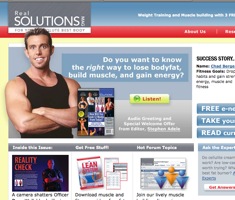
As CEO of iSatori Technologies LLC and editor in chief of Real SOLUTIONS magazine, Stephen Adele knows a lot about healthy living. His company offers dietary supplements, nutritional plans and intelligent training programs to help people look and feel better. The quarterly magazine focuses on giving people smart nutrition, lifestyle and training strategies. Here, Adele talks about the best way to tailor your nutrition to live a healthier lifestyle.
What is your definition of health?
My definition of health, and it may differ from others, is that [health is a] very interesting concept that you can’t really measure. Do you feel healthy and look healthy? People can look healthy and not be healthy; likewise, people can feel healthy and not look fit. For me, I feel health is when you’re feeling and living optimally. When you just feel good, you’re confident and you feel like you look good. You have a definition of what you always think you should look like. When you’re meeting that, you’re going to feel good about the way you look.
What are the best and worst diet programs?
Many popular fad diets tell you that carbohydrates are the enemy, yet how do you eliminate carbs unless you eat only protein and fat? To solve that dilemma, the food industry created a loophole labeling concept called “net impact carbs.” In calculating carbohydrates for the required package labeling, they replace some of the carbs with substances that your body cannot process, such as fiber and sorbitol (sugar alcohol). Since the FDA doesn’t include those substances when calculating carbohydrates, they aren’t included in the net carb count. But those additives still have calories, and excess calories cause weight gain. You’d be better off eating less food and more real carbohydrates.
The best diet plans follow sound nutritional guidelines. They focus more on portion sizes than on eliminating macronutrients like carbohydrates, proteins or fats. Good examples are the diet plans that recommend eating balanced meals. Fad plans like the Atkins and South Beach diets promise a quick fix, but I kind of shrug my shoulders and tell people to try it if they want, but they won’t last long.
What’s the difference between people who lose weight and keep it off and people who gain it back?
Successful people are really no different from unsuccessful people. But successful people follow successful habits and unsuccessful people follow unsuccessful habits. Unsuccessful people find excuses. Successful people make a concrete decision that enough is enough. Unsuccessful people cannot decide when the right time is to make a change. Successful people make an open announcement to at least one person other than themselves that they’re going to change the way they look and feel. That’s important. People who have a support group are four times more likely to succeed. Unsuccessful people try to keep it a secret because they’re so scared they’ll fail.
Do diet pills work?
Pharmaceutical drugs have their place; they’ve saved a lot of lives. But when it concerns weight loss, I advise people to resort to diet and exercise first. Try incorporating practical measures first, and not just for a few weeks. If that doesn’t work, some drugs have proven useful. Stimulant drugs may suppress your appetite, but as soon as you stop taking them, you quickly make up for all those lost days of eating. Another drug product, which comes from crab shells, claims to absorb and excrete up to seven times its weight in fat. However, it comes with a long list of side effects that can injure your health. Bottom line—there’s no quick fix. You can’t just eat what you want and then take a pill.
What about supplements?
Since I sell, manufacture and market dietary supplements, you’d probably expect me to say, “It’s all about the supplement,” but I won’t. A supplement is just that: a supplement to your diet, training and lifestyle. Supplements can help you achieve results when they’re integrated with proper training, planning and knowledge. Sadly, there will always be people who want the magic pill, and there will always be companies that advertise a quick fix.
To tell whether a supplement can back up its claims, look for “the gold standard” of clinical research: independent, double-blind, placebo-control, randomized studies. This is the same type of testing pharmaceutical companies use. For example, on our weight loss supplement called Lean System 7, an independent research firm in Minnesota studied 45 slightly overweight but otherwise healthy adults (male and female) during an eight-week program. One group took a flour placebo and one group took Lean System 7. Both groups followed the same nutritional and exercise programs (walking three days a week). The tests showed that Lean System 7 helped people achieve their results three times faster than the placebo and was just as safe as the placebo. Show me another supplement company that can provide you with the same thing. Most can’t, because they won’t invest in testing; they just spend their money on marketing.
What’s the next big trend in food and nutrition?
I believe all foods, maybe in five years, will be marked with an insignia that states the glycemic index of that food. The glycemic index is a scale that compares the effects of food to the effects of table sugar. If you ate a tablespoon of sugar, you would have certain changes in your blood sugar and insulin levels. If you understand the glycemic index and how to use it to your advantage, you’ll know which foods to eat and which foods to stay away from.
For more information about Stephen Adele, visit www.realsolutionsmag.com.
About Stephen Adele
As CEO of iSatori Technologies LLC and editor in chief of Real SOLUTIONS magazine, Stephen Adele knows a lot about healthy living. His company offers dietary supplements, nutritional plans and intelligent training programs to help people look and feel better. The quarterly magazine focuses on giving people smart nutrition, lifestyle and training strategies.



| "Ariane is a new voice who can inspire and inform all of us going through change, whether it be big or small, professional or personal. The First 30 Days will encourage people going through change to go from being fearful and alone to feeling optimistic and transformed."— David Bach, New York Times best-seller | "Since change is the only constant in life, it helps to have an expert navigate through the ups and downs of life. The First 30 Days is an excellent guide."— Deepak Chopra, New York Times best-seller | "Essential reading for anyone going through a change. I loved it!"— Wayne Dyer, New York Times best-seller |

Family Being Pregnant Being a New Dad Grieving Stepparenting
Home Selling a Home Buying a Home Surviving a Natural Disaster Creating a Green Home Your Empty Nest Remodeling Your Kitchen Buying a New Car
Relationships Improving Your Sex Life Getting Divorced Breaking Up Finding Romance Improving Relationships Dating Online
New Directions Pursuing Your Dreams Being Happier Changing Your Look Getting Organized Making Change Easier Moving to a New City Living More Spiritually Meditating Going Green
Health Dealing With Depression Quitting Smoking Managing Breast Cancer


My love life has changed for better since the interference of the most powerful spell caster on earth called Dr.Atase in my relationship, My testimony today is in regard of the help that Dr.Atase render me when my lover departed from me. My name is Anabel from USA and it gives me joy today in writing this testimony as a way of showing my appreciation to Dr.Atase and at the same time i am using this opportunity to advise those that are finding stress and pains in their relationship or marriages to contact Dr.Atase who is the best spell caster in the world through these contact details via email: indiaspelltemple@yahoo.com or his number +2348112796070.Because Dr.Atase is the only one that can restore your marriage or relationship with love. He can also help to win lottery spell,contract,sickness and more.
Hello dear friend,
To love someone is nothing, to be loved by someone is something, to love
someone who loves you is everything. Looking here for everything of my
life, I write some words. I am single and not engaged. I am in search of
true happiness and am hoping the future brings it. I am almost too honest
for my own good - and hate game playing.
nI am trying to handle some pretty encompassing issues in my life... but am
waiting to remain open-minded where the idea of romance exists. I am
looking for Honest, caring, patient, funny and loyal person. A man that
can be himself in the beginning and remain that same person all the way
through to the end of time !
nIf you are willing to love and be loved with your whole heart & willing to
make the people in your life a "solid' part of your soul... then maybe you
and I will connect. We might just have a lot to talk about through my
private e-mailbox(maryluveu@hotmailcom)
my contact info is.
Take care,
Ms mary maryluveu[at]ho/t/m/a/i/l/com
"For me, I feel health is when you’re feeling and living optimally."
I would like to add thinking (optimally).
Following on from the question - What’s the next big trend in food and nutrition? - I would like to ask, what is the best kind of food for thought? Could spontaneity be considered a nutrition for the mind?
Thank you for sharing.
Serenity n' joy,
Richard